注:本文为阅读 muduo 源码库和作者著作之后的网络库复现和笔记
在传统的 IO 多路复用系统中,定时操作通常是直接去设置poll()等函数的超时时间,系统超时之后去执行对应的定时回调。但现代 Linux 系统已经将时间也抽象为了一种事件 ,并提供了对应的文件描述符fd机制,其能够被poll()等多路复用函数进行监视,因此可以很简洁地融入到我们之前实现的 Reactor 机制中。这也是更科学的做法。
底层 API
int timerfd_create(int clockid, int flags)fd。clockid设置时钟的类型,flags则是设置fd的各个标志位,比如是否阻塞等等。
int timerfd_settime(int fd, int flags, const struct itimerspec *new_value, struct itimerspec *old_value)new_value去设定 timer 的超时时间(expiration time)以及是否重复(repeat via same iterval)。需要注意的是,new_value默认情况下指的是基于 timer 当前时刻的相对时间 ,如果需要设置绝对时间,则需要更改flags参数。
模块设计 定时设置,也就是用户指定一个时刻和一个回调函数,系统需要在该时刻去执行该回调函数。这个定义包含了两层含义:
用户的定时设置是任意的。有可能先设置一个 10 秒的定时,接下来再设置一个 5 秒的定时。用户不一定会以 expiration time 的先后顺序去设置定时;
系统顺序执行回调函数。系统需要将所有注册过的定时事件,按照 expiration time 的先后顺序,在用户设置的每一个 expiration time 去执行对应的回调函数;
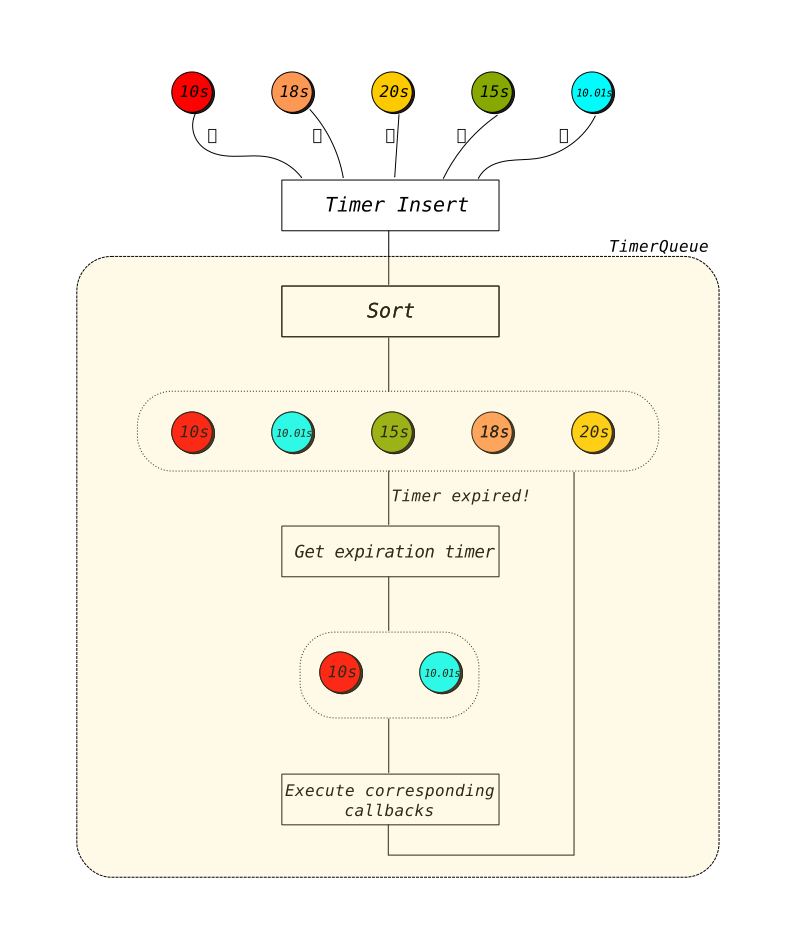
基于上述的特点,我们需要的定时器模块的流程示意如图 1 所示。
首先解释一下图 1 所示的流程:
class Timer: 显然每一个 expiration time 都对应着一个 callback function,因此将其封装为一个类class Timer,方便执行各自的回调函数。在图中即对应着五个不同颜色的小圆圈;接口:TimerQueue 向用户提供Timer Insert接口,供用户插入各个 Timer。在图中,我们先后插入了 expiration time 为 10s, 18s, 20s, 15s, 10.01s 的 Timer;
class TimerQueue内部过程:① 将得到的所有 Timer 进行排序;② 每当有新的 Timer expired 之时,抽取出过期的 Timer,在图中对应着 10s 和 10.01s 两个 Timer;③ 依次执行这些 expired Timer 的回调函数;
接下来则是根据流程所示的特点去分析如何构建class TimerQueue:
首先是何时执行timerfd_create()。这个很简单,自然是在构造函数中执行,将得到的 timer fd 作为class TimerQueue的成员变量;
其次是何时执行timerfd_settime()。这个是需要重点思考的问题。最直接的解决方案自然是每插入一个 Timer 就执行一次timerfd_settime(),对应图 1 的例子,系统就会将 10s, 10.01s, 15s, 18s, 20s 这几个时刻都设置为过期时刻,随后在每一个过期时刻将对应的 Timer 取出,并执行回调函数。但这个方案有一个潜在的问题。timerfd_settime()是系统调用 ,频繁的调用会导致系统开销增大。timerfd_settime()。具体而言分两种情况:
新插入一个 Timer:在插入 Timer 之前比较该 Timer 和 TimerQueue 中排名最靠前的 Timer 的 expiration time,如果在其之前,则增设一个timerfd_settime();
取出过期的 Timer:在取出了过期的 Timer 之后,如果 TimerQueue 中还有剩余的 Timer,则再对残余的 Timer 中最靠前的那一个 Timer 设置timerfd_settime()
随后是如何组织 TimerQueue 中的 Timer。我们必须保证有序,而插入新 Timer 的位置又是随机的。综合考虑,使用std::set是最方便的。问题是如果存在 expiration time 相同的 Timer 怎么办。muduo 源码给出的解决方法很巧妙,其将std::set的元素设置为std::pair<TimeStamp, Timer *>,这样一来就完美的解决了问题,即使两个 Timer 的过期时刻一致,在std::set中也还能用 Timer 的地址去排列各个 Timer 的先后顺序。
最后就是将class TimerQueue集成到 EventLoop 中,也就是作为class EventLoop的成员变量,这个很简单,不再赘述。
实现过程中的一些知识点总结
CLOCK_REALTIME和CLOCK_MONOTONICtimer_create()中需要使用这些标志符去设定clockid(当然还有一些其他标识符可供选择)。这两个标识符的区别是:CLOCK_REALTIME基于实际的系统时间,可设定,非单调;CLOCK_MONOTONIC基于的是一个不确定的时间点,并单调流逝,其不可设定,绝对单调。为什么说CLOCK_REALTIME是非单调的呢?原因很简单,因为系统时间本身就是可以被用户任何修改的。具体详见博客1
代码实战 1 2 3 4 5 6 7 8 9 10 11 12 13 14 15 16 17 18 19 20 21 22 23 24 25 26 27 28 29 30 31 32 33 34 35 36 37 38 39 40 41 42 43 44 45 46 #ifndef TIMERQUEUE_H #define TIMERQUEUE_H #include <muduo/base/Timestamp.h> #include <set> #include <vector> #include <memory> #include <boost/noncopyable.hpp> #include "Channel.h" class EventLoop ;class Timer ;class TimerId ;class TimerQueue :{ using Entry = std ::pair <muduo::Timestamp, Timer *>; using TimerList = std ::set <Entry>; using TimerCallback = std ::function<void ()>; private : EventLoop *loop_; const int timerfd_; TimerList timers_; Channel timerfdChannel_; std ::vector <Entry> getExpired (muduo::Timestamp now) bool insert (Timer *) void resetTimerfd (muduo::Timestamp when) public : TimerQueue(EventLoop *); ~TimerQueue(); TimerId addTimer (const TimerCallback cb, muduo::Timestamp time, double interval) ; void addTimerInLoop (Timer *timer) void handleRead () void reset (std ::vector <Entry> &expired, muduo::Timestamp now) }; #endif
1 2 3 4 5 6 7 8 9 10 11 12 13 14 15 16 17 18 19 20 21 22 23 24 25 26 27 28 29 30 31 32 33 34 35 36 37 38 39 40 41 42 43 44 45 46 47 48 49 50 51 52 53 54 55 56 57 58 59 60 61 62 63 64 65 66 67 68 69 70 71 72 73 74 75 76 77 78 79 80 81 82 83 84 85 86 87 88 89 90 91 92 93 94 95 96 97 98 99 100 101 102 103 104 105 106 107 108 109 110 111 112 113 114 115 116 117 118 119 120 #include <sys/timerfd.h> #include <unistd.h> #include "TimerQueue.h" #include "Channel.h" #include "Timer.h" #include "EventLoop.h" #include "TimerId.h" int creatTimerFd () return ::timerfd_create(CLOCK_MONOTONIC, TFD_NONBLOCK | TFD_CLOEXEC); } struct timespec getTimeDiffFromNow (muduo::Timestamp when) { auto microSeconds = when.microSecondsSinceEpoch() - muduo::Timestamp::now().microSecondsSinceEpoch(); if (microSeconds < 100 ) microSeconds = 100 ; struct timespec ret ; ret.tv_sec = static_cast <time_t >(microSeconds / muduo::Timestamp::kMicroSecondsPerSecond); ret.tv_nsec = static_cast <__SYSCALL_SLONG_TYPE>( (microSeconds%muduo::Timestamp::kMicroSecondsPerSecond) * 1000 ); return ret; } std ::vector <TimerQueue::Entry> TimerQueue::getExpired (muduo::Timestamp now) Entry dummy{now, reinterpret_cast <Timer *>(UINTPTR_MAX)}; auto end_ = timers_.lower_bound(dummy); assert(end_==timers_.end() || now<end_->first); auto ret = std ::vector <Entry>(timers_.begin(), end_); timers_.erase(timers_.begin(), end_); return ret; } TimerId TimerQueue::addTimer (const TimerCallback cb, muduo::Timestamp time, double interval) Timer *timer = new Timer(cb, time, interval); loop_->runInLoop(std ::bind(&TimerQueue::addTimerInLoop, this , timer)); return TimerId(timer, timer->sequence()); } void TimerQueue::addTimerInLoop (Timer *timer) loop_->assertInLoopThread(); auto isEarliest = insert(timer); if (isEarliest){ resetTimerfd(timer->expiration()); } } TimerQueue::TimerQueue(EventLoop *loop): loop_(loop), timerfd_(creatTimerFd()), timers_(), timerfdChannel_(loop, timerfd_) { timerfdChannel_.setReadCallback(std ::bind(&TimerQueue::handleRead, this )); timerfdChannel_.enableRead(); } TimerQueue::~TimerQueue(){ ::close(timerfd_); for (auto itr = timers_.begin(); itr != timers_.end(); ++itr){ delete itr->second; } } void TimerQueue::handleRead () loop_->assertInLoopThread(); muduo::Timestamp now (muduo::Timestamp::now()) ; auto expiredList = getExpired(now); for (auto &expired: expiredList){ expired.second->run(); } reset(expiredList, now); } void TimerQueue::reset (std ::vector <Entry> &expired, muduo::Timestamp now) muduo::Timestamp when; for (auto &e: expired){ if (e.second->repeat()){ e.second->restart(now); insert(e.second); } } if (!timers_.empty()){ when = timers_.begin()->first; } else { when = muduo::Timestamp::invalid(); } if (when.valid()){ resetTimerfd(when); } } bool TimerQueue::insert (Timer * timer) bool isEarliset = false ; auto itr = timers_.begin(); if (itr==timers_.end() || timer->expiration()<itr->first){ isEarliset = true ; } timers_.insert({timer->expiration(), timer}); return isEarliset; } void TimerQueue::resetTimerfd (muduo::Timestamp when) itimerspec old_timerspec, new_timerspec; bzero(&old_timerspec, sizeof old_timerspec); bzero(&new_timerspec, sizeof new_timerspec); new_timerspec.it_value = getTimeDiffFromNow(when); ::timerfd_settime(timerfd_, 0 , &new_timerspec, &old_timerspec);; }
1 2 3 4 5 6 7 8 9 10 11 12 13 14 15 16 17 18 19 20 21 22 23 24 25 26 27 28 29 30 31 32 33 34 35 36 37 38 39 40 41 42 43 44 45 46 47 48 #ifndef TIMER_H #define TIMER_H #include <functional> #include <muduo/base/Timestamp.h> #include <muduo/base/Atomic.h> #include <boost/noncopyable> class Timer :{ using TimerCallback = std ::function<void ()>; private : TimerCallback callback_; muduo::Timestamp expiration_; double interval_; bool repeat_; int64_t sequence_; static muduo::AtomicInt64 sequenceNumGenerator_; public : Timer(const TimerCallback &cb, muduo::Timestamp when, double itv); ~Timer(); muduo::Timestamp expiration () const { return expiration_; } double interval () return interval_; } int64_t sequence () const return sequence_; } bool repeat () const return repeat_; } void run () callback_(); } void restart (muduo::Timestamp when) }; #endif
1 2 3 4 5 6 7 8 9 10 11 12 13 14 15 16 17 18 19 20 21 22 23 24 25 26 #include "Timer.h" muduo::AtomicInt64 Timer::sequenceNumGenerator_; Timer::Timer(const TimerCallback &cb, muduo::Timestamp when, double itv) : callback_(cb), expiration_(when), interval_(itv), repeat_(itv>0 ), sequence_(sequenceNumGenerator_.incrementAndGet()) { } Timer::~Timer(){ } void Timer::restart (muduo::Timestamp when) if (repeat_){ expiration_ = muduo::addTime(when, interval_); } else { expiration_ = muduo::Timestamp::invalid(); } }
1 2 3 4 5 6 7 8 9 10 11 12 13 14 15 16 17 18 19 20 21 22 23 24 25 26 27 28 #ifndef TIMERID_H #define TIMERID_H #include <cstdint> class Timer ;class TimerId { private : Timer *timer_; int64_t sequence_; public : TimerId(): timer_(nullptr ), sequence_(0 ){ } TimerId(Timer *t, int64_t sequ): timer_(t), sequence_(sequ) { } }; #endif
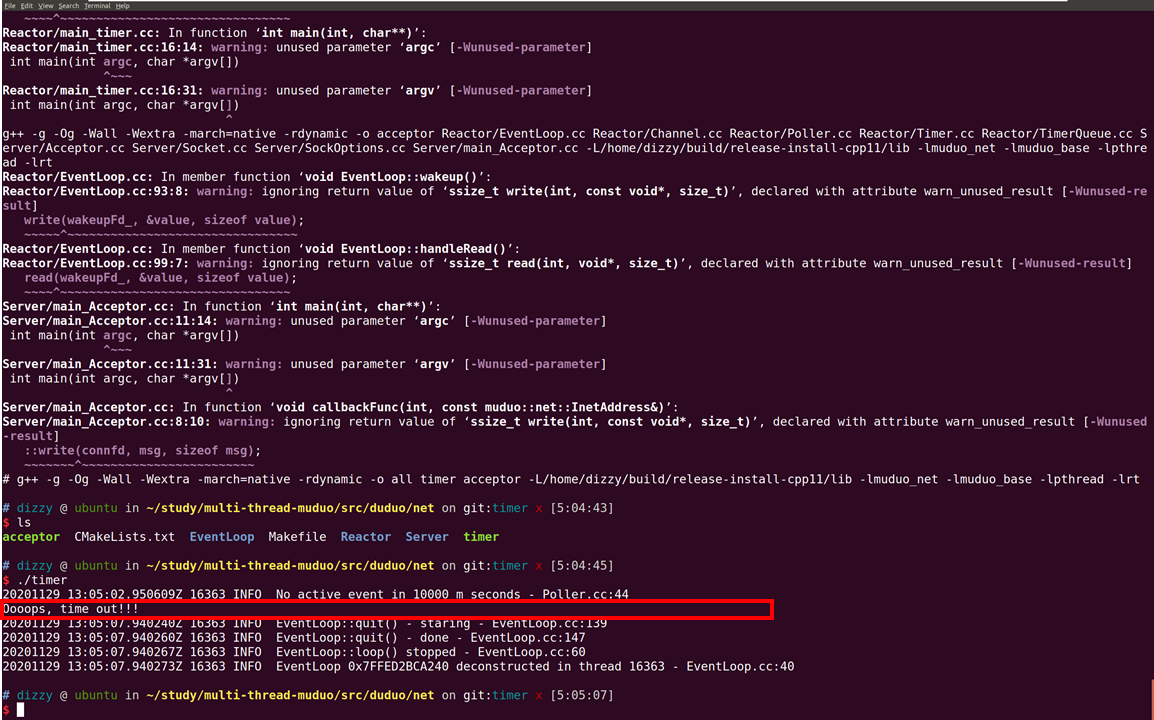
1 2 3 4 5 6 7 8 9 10 11 12 13 14 15 16 17 18 19 20 21 22 23 24 25 26 #include "EventLoop.h" #include <muduo/base/Thread.h> #include "TimerId.h" EventLoop *g_loop; void timeOutFunc () printf ("Oooops, time out!!!\n" ); g_loop->quit(); } void threadFunc () g_loop->runAfter(15 , &timeOutFunc); } int main (int argc, char *argv[]) EventLoop loop; g_loop = &loop; muduo::Thread thread_ (&threadFunc) ; thread_.start(); loop.loop(); return 0 ; }
结果演示
Reference